
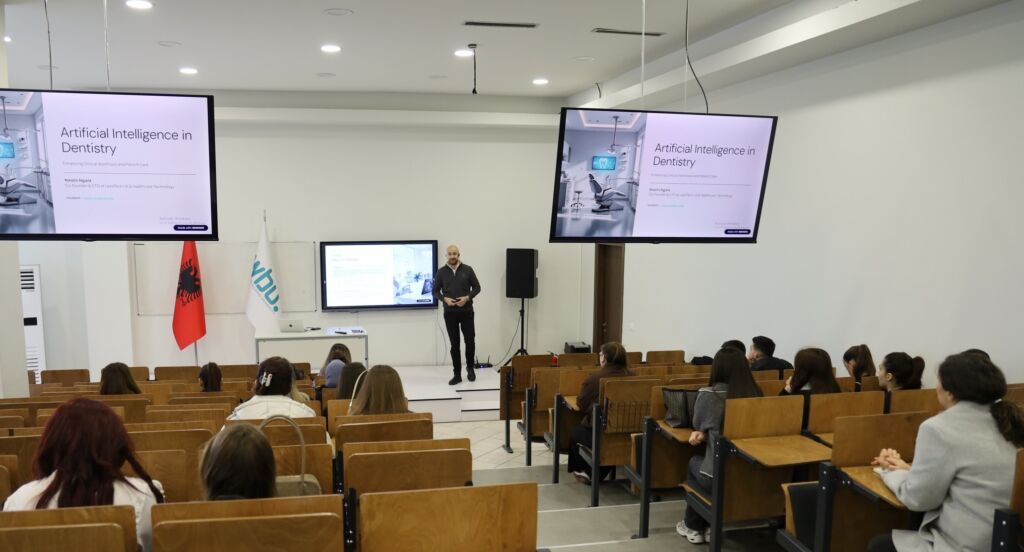
Last week I had the chance to present at Western Balkan University in Tirana a topic that’s becoming impossible to ignore: Artificial Intelligence in Dentistry.
Honestly, their curiosity made it one of the best talks I’ve done so far. These are the people who will be sitting in clinics in a few years, and the tools they’ll use will look nothing like what’s available today.
Why this matters now
Dental clinics are under real pressure. Patients expect fast answers, clear communication, and follow-up that doesn’t fall through the cracks. At the same time, the staff is buried in scheduling, confirmations, charting, and paperwork. Something has to give.
That was the starting point of the presentation not “AI is cool” but “AI solves actual problems that clinics deal with every single day.
AI in Dentistry at Western Balkan University
What we covered
We talked through the areas where AI is already making a difference in dental practice:
Workflow automation — the boring stuff that eats hours every week. Scheduling, reminders, confirmations. When a machine handles these, the staff can focus on patients instead of phones.
Voice-to-report clinical scribes — during a consultation, AI listens and turns the conversation into structured clinical notes. No more typing up everything after the patient leaves. This is something we’re actively building at VoixDent.
Post-operative monitoring — this one got a lot of attention from the students. After an extraction or implant placement, patients often don’t get consistent follow-up. AI-driven check-ins can catch complications early, without the clinic needing to call every patient manually.
Multilingual patient communication — especially relevant here in the Balkans and across Europe where dental tourism is growing fast. A patient from Germany or Italy should be able to communicate with a clinic in their own language from the first message.
Radiograph interpretation support — AI models trained on dental imaging data can help clinicians spot things like caries, bone loss, or anomalies that might get missed during a quick review. This isn’t about replacing the dentist’s eye — it’s about giving them a second opinion that never gets tired.
Final thoughts
What I appreciated most about this session was that the discussion stayed grounded.
There was interest, curiosity, and openness but also seriousness. That is exactly the kind of conversation AI in healthcare needs. Less noise. More substance. Less hype. More clinical value.
I’m grateful for the opportunity to share this discussion at the university, and I’m even more encouraged by the fact that future clinicians are already asking great questions.